
Project Brief
Client Type: Health education platform, preventive cardiology clinic, or direct-to-consumer diagnostic testing company
Assignment: Create accessible content explaining advanced lipid testing to patients with moderately elevated cholesterol levels.
Challenge: Balance scientific accuracy with readability for non-specialists. Empower patients to ask for better testing without undermining physician authority.
Solution: Applied the “highway analogy” to make LDL-P vs LDL-C intuitive. Cited landmark studies to build trust and added a clear “next step” for readers.
Metrics for Success:
- Reader comprehension of key concept (particle number > cholesterol amount).
- Increased awareness and requests of advanced lipid testing.
- Reduced patient anxiety about moderately elevated LDL-C values.
Why Half of Heart Attack Patients Have ‘Normal’ Cholesterol—And What to Measure Instead
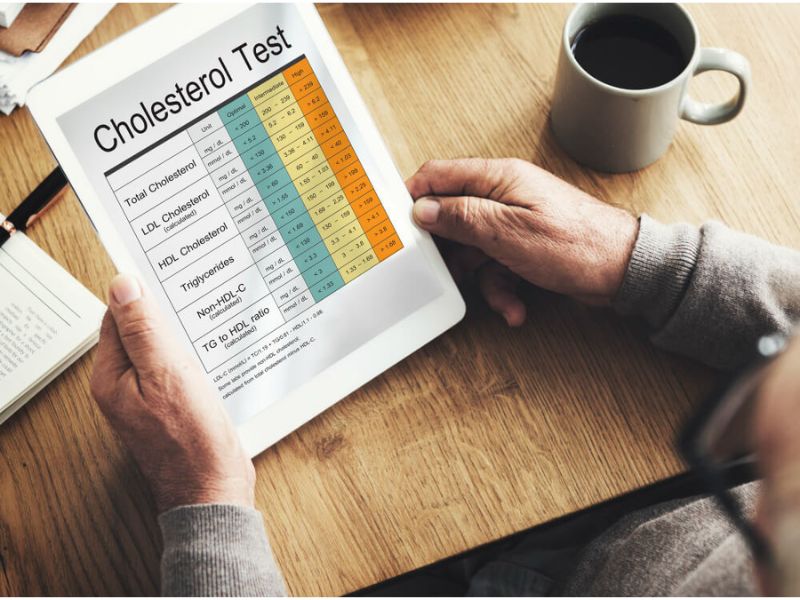
You get your blood test results:
Total cholesterol: 230 mg/dL.
A red flag.
You Google “cholesterol” and ten minutes later, you’ve self-diagnosed with three heart conditions and started drafting your will.
Before you panic, let’s unpack what those numbers really mean.
Let’s be clear: No cholesterol, no life.
Cholesterol is essential for our bodies:
- It’s a component of our cell membranes.
- Helps bile production (for digesting fats).
- Helps create vitamin D.
- It insulates parts of nerve cells, helping them send signals faster.
- It’s the raw material of sex hormones.
Although dietary intake can influence levels in some individuals (hyper-responders), most of your cholesterol doesn’t come from food—it comes from you.
Your own cells make it, and your liver produces the rest as needed.
But there’s an important detail about cholesterol: it hates water (it’s hydrophobic).
To move around in your blood (which is mostly water), it needs a ride.
And it uses the lipoproteins.
Think of cholesterol as the passengers, lipoproteins as the cars, and your bloodstream as the world’s busiest highway.
How cholesterol moves in your body:
As you can guess, lipoproteins are made of lipid + proteins.
The most popular lipoproteins are HDL (High Density Lipoprotein) and LDL (Low Density Lipoprotein).
When talking about the lipoproteins, we add the “P” (for particle) to differentiate them from the cholesterol they carry:
HDL-P: lipoprotein (or particle) that carries cholesterol.
HDL-C: cholesterol carried by HDL-P.
LDL-P: lipoprotein (or particle) that carries cholesterol.
LDL-C: cholesterol carried by LDL-P.
There are more lipoproteins (VLDL, IDL, and chylomicrons), but for simplicity, let’s focus in the two main ones.
The ratio of protein/lipid is what the determines what kind of lipoprotein we are talking about.
VLDL has more lipids (cholesterol + triglycerides) than IDL and, IDL in turn, more than LDL with finally HDL having the lowest amount of lipids.
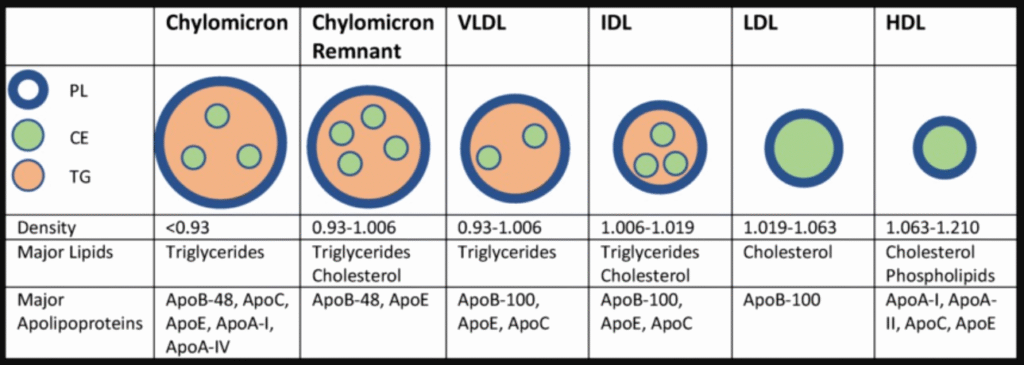
PL: Phospholipids
CE: Cholesterol
TG: Triglycerides
Remember the following information for later:
- The protein part in a lipoprotein is called “apolipoprotein”.
- The apolipoprotein in LDL-P is called ApoB.
Why standard cholesterol tests fall short?
Typical blood tests, only give you these data:
- Total cholesterol: all the passengers travelling in different lipoproteins.
- Triglycerides (other type of passenger).
- HDL: the cholesterol carried in the HDL, the HDL-C but not the total HDL-P.
And what about LDL-C (the “bad cholesterol” number on your test)?
It’s only estimated using a math formula—not directly measured [resource]
This value, the LDL-C commonly known as ‘bad’ cholesterol, it’s actually a poor indicator of coronary risk.
A study published in the American Heart Journal assessing nearly 140,000 hospitalizations, showed almost half of patients with heart attacks had LDL levels below the recommended threshold [2]
So if LDL-C isn’t the best predictor, what is?
To answer that, we need to understand how heart disease actually begins.
Atherosclerosis: the origin of heart disease.
As we just saw, there is only one type of cholesterol. What changes is the type of vehicle where it is transported.
And that’s the key to understand why heart disease happens.
Atherosclerosis begins when too many lipoproteins slip beneath the artery’s protective inner wall (called the endothelium) and get trapped there.
And which are the lipoproteins that tend to accumulate?
The LDL-P, not the cholesterol itself.
And why the LDL-P are the most dangerous?
Because they bind more strongly to the arterial wall and circulate longer, giving them more opportunities to accumulate, oxidize (like rust on metal) and trigger inflammation.
For these reasons, the number of LDL particles is a far better indicator of coronary risk than the total cholesterol they carry [3].
Similar conclusions are presented by the Framingham, one of the largest studies about cardiovascular disease. [4]
Back to the highway analogy.
A road with 20 cars (or LDL-P) and 4 people (cholesterol) in each, would have fewer accidents than if there were 80 cars with only one passenger in each.
Two patients may have the exact same values in a traditional blood test (LDL-C and triglycerides) but have very different risks, due to varying particle numbers (LDL-P).
Of course, there is a correlation between LDL-C and LDL-P, but in 1 out of 4 people, standard tests show “normal” LDL-C when their particle count (LDL-P) is dangerously high.
They look fine on paper, but are actually at risk [3].
If your cholesterol levels worry you, talk to your doctor about getting an LDL-P test before jumping on statins for the rest of your life.
The numbers might surprise you.
How to measure your LDL-P
There are two ways:
- Measure directly the LDL-P with NMR (nuclear magnetic resonance) that counts particles directly. This method is more accurate, but pricier.
- Measure the ApoB (remember, that’s the protein marker on LDL particles—one ApoB per particle). This gives you an accurate particle count without the expensive NMR test.
Note: even ApoB is also present in VLDL and IDL particles, LDL particles comprise ~90-95% of total ApoB-containing particles.
Another complementary data you may consider is the c-reactive protein, which reflects the level of inflammation, infection, or tissue damage in your body.
It’s not conclusive, but it can add information about potential damage to your endothelium.
Key Takeaways
What matters most: The number of LDL particles (LDL-P), not just the cholesterol they carry (LDL-C).
Why it matters: Nearly 50% of heart attack patients had “normal” LDL-C as standard tests can miss hidden risks.
What to ask for: Talk to your doctor about an ApoB test (simpler, cheaper) or an NMR lipid panel (more detailed).
What not to do: Don’t start or stop medications based on this article, use it as a conversation starter with your physician.
Disclaimer: This article is for educational purposes only and does not replace professional medical advice.
References:
[1] Genetics of Triglyceride-Rich Lipoproteins Guide Identification of Pharmacotherapy for Cardiovascular Risk Reduction – Scientific Figure on ResearchGate. Available from: https://www.researchgate.net/figure/Lipoprotein-classes-and-composition_tbl1_350019663
[2] Sachdeva A, Cannon CP, Deedwania PC, LaBresh KA, Smith SC, Dai D, Hernandez A, Fonarow GC. Lipid levels in patients hospitalized with coronary artery disease: an analysis of 136,905 hospitalizations in Get With The Guidelines. Am Heart J. 2009;157(1):111-117.e2. doi:10.1016/j.ahj.2008.08.010
[3] Otvos JD, Mora S, Shalaurova I, Greenland P, Mackey RH, Goff DC Jr. Clinical implications of discordance between low-density lipoprotein cholesterol and particle number. J Clin Lipidol. 2011;5(2):105-113. doi:10.1016/j.jacl.2011.02.001
[4] Cromwell WC, Otvos JD, Keyes MJ, Pencina MJ, Sullivan L, Vasan RS, Wilson PWF, D’Agostino RB. LDL particle number and risk of future cardiovascular disease in the Framingham Offspring Study—implications for LDL management. J Clin Lipidol. 2007;1(6):583-592. doi: 10.1016/j.jacl.2007.10.001